
Revision ACL Reconstruction
Revision ACL reconstruction is a second (or third) surgery to rebuild an ACL after a previous reconstruction has torn or stopped working. It is a different operation from a first-time ACL reconstruction, because the knee already has tunnels in the bone, hardware, and a graft from the first surgery, and every revision has to be planned around what was done before.
I do about 100 ACL surgeries a year, and many of the patients I see for revision had their first surgery somewhere else. This is very common. In a large study from New Zealand, 44.5% of revision surgeries were done by a different surgeon than the one who did the original reconstruction.
At the first visit, the most important thing I do is figure out why the first ACL failed, since if we do not answer that question there is a real risk of repeating the same failure. Sometimes I need a CT scan or an additional MRI to see why the graft failed, and I also review the operative report from the first surgery. The most common reasons are explained below.
The ACL videos on this page cover the ACL injury, graft choice, reconstruction and recovery, and I talk about revision ACL surgery in them as well. They are a good place to start before your visit.
Video Education
Dr. Merritt has developed an in-depth video series on ACL injury, surgical options, and recovery. These videos help patients understand the condition, the procedure, and what to expect.
Why ACL Grafts Fail
In general, failures fall into three groups.
- Traumatic re-tear. The first surgery was done well and the graft healed, and then there was a new injury such as a hard cut, a bad landing, or a collision. This is the single most common cause.
- Technical failure, meaning a problem with the first surgery. The most common technical problem is a graft placed in the wrong spot, usually a femoral tunnel that is too vertical (too high in the notch), and in the largest revision study to date femoral tunnel position was the most common technical error. Hardware problems, a graft that was too small, or a missed injury to another ligament or the meniscus also fall into this group.
- Biologic failure, where the graft never healed into a living ligament. This usually happens when the wrong graft was chosen for the patient, most often donor tissue (allograft) in a young athlete, and the knee may slowly loosen over months without any single injury.
In reality, many failures are a combination. In the Multicenter ACL Revision Study (MARS), surgeons judged failures to be traumatic in 32% of cases, technical in 24%, biologic in 7%, and a combination of factors in 37%.
One of the most common patterns of failed ACL that I see in the revision setting is a vertical ACL tunnel from the original surgery. It was common in the 2000s and 2010s to do the drilling onto the femur in a different way, which did not match the anatomical positioning of the native ACL. This led to a graft that was too vertical, meaning that it was positioned poorly on the femoral side. Functionally, this leads to a knee that still allows rotational motion and does not do the job of an ACL in stopping rotational motion. Therefore, patients will often have a knee that still has a pivot shift on the examination, since it is poorly positioned. This often necessitates bone grafting to do a staged revision ACL reconstruction.
The other big failure point that I see is using cadaver tissue. Cadaver tissue use varies around the country, and some surgeons use it even in young patients, which is well shown to be inferior to using their own tissue.
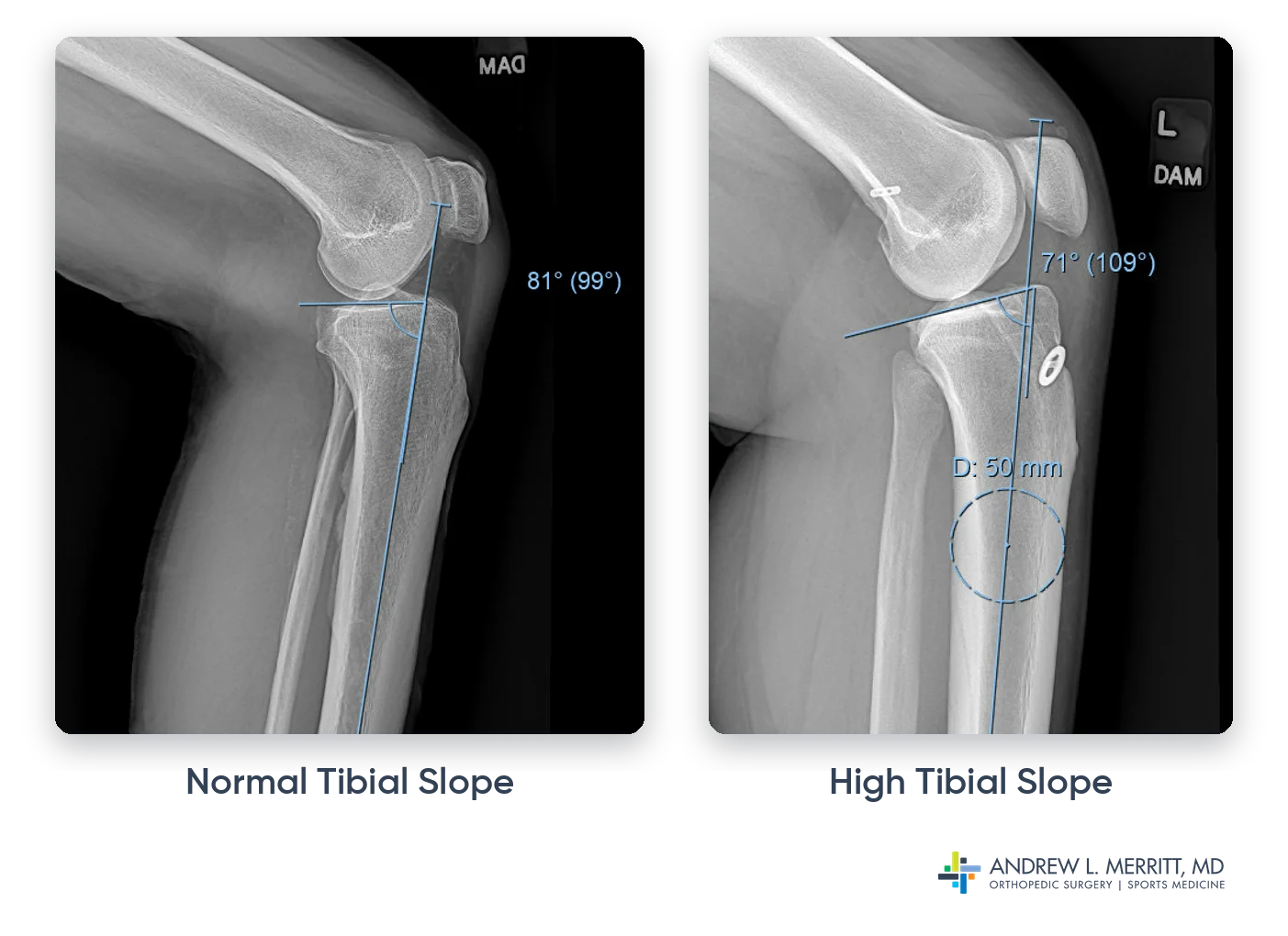
At the first visit we talk about all of the reasons a graft can re-tear. The easiest situation is just a traumatic re-tear, where we will do a revision ACL reconstruction and add in a lateral extra-articular tenodesis. Of course, this can often get more complicated if the tunnels are dilated or not in a good position, and then we have to talk about staged revision surgery. Finally, we also have to consider other anatomical factors like valgus alignment, hypermobility, or an increased slope of the shin bone (tibia) that contribute to the risk of re-tear. In most situations we are adding a lateral extra-articular tenodesis, especially in patients who are high risk.
Treatment Options
Not everyone with a failed ACL needs another surgery. If your knee feels stable for what you do and you are willing to give up cutting and pivoting sports, focused physical therapy is a reasonable choice. For most active people whose knee keeps giving way, though, a revision is the right answer, because each giving-way episode can damage the meniscus and cartilage and that damage is permanent.
My approach to revision ACL reconstruction is built on a few principles.
I use your own tissue whenever possible. In revision surgery I use autograft (your own tendon) instead of donor tissue whenever I can, since the MARS study, which is the largest study of revision ACL surgery, found that patients revised with their own tissue were 2.78 times less likely to re-rupture their graft at 2 years than patients revised with donor tissue. Depending on what was used the first time, the graft may be the quadriceps tendon, the patellar tendon, or the hamstring tendons, and sometimes a tendon from the other knee.
I add a lateral extra-articular tenodesis (LET) in almost every revision. An LET uses a thin strip of the iliotibial (IT) band on the outside of the knee to control rotation and protect the new graft. I add it to most of my high-risk primary ACL surgeries already (why I add LET to ACL reconstruction), and a revision is about as high-risk as it gets. A meta-analysis of revision ACL studies found that adding a lateral procedure lowered the odds of failure by about 56% compared with a revision alone. You can read more on my LET page and in my LET surgery guide.
The new graft has to go in the right place. Vertical grafts cause the knee to continue to pivot because the outer side of the knee just rotates around the vertical graft. In order for a graft to stop a pivoting motion, it has to be at a good obliquity to the joint. If the graft is vertical, it may stop anterior translation, but a vertical graft has no fibers in an orientation that would allow the knee to stop pivoting.
Staged (Two-Stage) Revision ACL Reconstruction
Staged reconstruction versus a single-stage revision is really determined by the size and position of the old tunnels. We always hope to do a single-stage revision, but if the tunnels are dilated from the previous graft, meaning that they have opened up to such an extent that they will not hold a new graft, then bone grafting is required. Likewise, if the tunnel position from the previous graft is thought to be at fault for the failure, sometimes we have to bone graft these so that we can choose the right tunnel location without being compromised by the previous tunnels.
Stage 1: I clean out the old ACL graft and hardware, fill the old tunnels with bone graft, and often add an LET at the same time. The LET helps control some of the rotational instability while you wait.
Stage 2: About 5 months later, once the bone graft has healed into solid bone (nutrition helps bone healing), I come back and do the real ACL reconstruction, with new tunnels in the correct position.
A staged revision takes longer and means two surgeries, but it gives the new graft solid bone to heal into. I would rather take the extra time than put a revision graft into bone that cannot hold it.
Recovery and Results
Recovery after a revision follows the same general course as a first-time ACL reconstruction, but I move it along more slowly. The graft fixation is often not as strong as in a primary surgery, the knee has usually been through more, and many patients also have meniscus or cartilage work done at the same time.
First 2 weeks. The focus is controlling swelling, getting the knee fully straight, and waking up the quadriceps muscle. You will use crutches and a brace at first. Physical therapy starts within the first week (ACL reconstruction PT protocol).
Weeks 2 to 6. The goals are walking normally with the knee fully straight and gaining bend week by week. Weight bearing and brace use depend on what else was done, especially if the meniscus was repaired (ACL with meniscus repair PT protocol).
Months 2 to 4. Strength work progresses to the bike, leg press, single-leg strength, and balance.
Months 4 to 6. Jogging and early agility start once strength and control allow it.
Months 6 to 9 and beyond. This phase is sport-specific training and formal return-to-sport testing, which includes strength measurements, hop tests, and an assessment of how you move. I do not clear anyone based on time alone. For most revision patients, return to cutting and pivoting sports is closer to 9 to 12 months, and sometimes longer.
If you have a staged revision, add the time between stages. After stage 1 most people walk normally within a few weeks and go back to daily activities, but sports stay off the table until after the second stage and full rehab.
Results. Revision ACL surgery does not get quite the same results as a first-time ACL reconstruction. The knee has often had more damage to the meniscus and cartilage, and re-tear rates are higher. Even so, most revision patients regain a stable knee and return to an active lifestyle, and many return to sport. The parts I control are using your own tissue, adding an LET, and correcting what went wrong the first time, and the other half is your work in rehab and ACL injury prevention training.
ACL Recovery Timeline
Drag the slider or select the post-operative time to explore each phase of your recovery
Surgery & Physical Therapy Resources
Discover detailed instructions and protocols to guide patients through Pre-Op, Post-Op and Physical Therapy from Dr. Merritt.
Related Articles
Read more from Dr. Merritt about revision ACL surgery, graft choice and LET.
Common Revision ACL Reconstruction Questions
Injury Information
A: Yes. Many of my revision patients had their first ACL surgery somewhere else. It helps a lot if you can bring your operative report along with any MRIs or X-rays, and if you do not have them, we can usually request them from your prior surgeon.
A: Older ACL techniques often placed the graft high and upright in the knee. A vertical graft can stop the shin bone from sliding forward, so the knee may test fine on a simple exam, but it does not control rotation well. As a result, some people with a “normal” looking ACL graft on MRI still feel the knee pivot and give way. The fix is a new graft placed in the anatomic position, usually with an LET added to control rotation.
A: If your knee feels stable for daily life and you are willing to stay away from cutting and pivoting sports, therapy alone can be reasonable. If your knee keeps giving way, or you want to return to sports like soccer, basketball, football, or skiing, I usually recommend a revision, since each giving-way episode risks permanent damage to the meniscus and cartilage.
A: There are three main reasons: a new injury (traumatic re-tear), a technical problem with the first surgery (most often a graft placed too vertically), or a biologic failure where the graft never fully healed (most often donor tissue in a young athlete). Many failures are a combination. Figuring out which one applies to you is the most important step in planning the revision.
A: The most common sign is the knee giving way again, especially when you twist, pivot, or change direction. Some people feel a new pop with an injury, while others notice the knee slowly getting looser over months without any single event. Repeated swelling, a feeling of the knee shifting, or not trusting it during sports are all reasons to get it checked. I confirm the diagnosis with an exam and an MRI.
Surgery Information
A: For most patients, yes. Revision ACL reconstruction is usually a same-day surgery at the Proliance Surgery Center at Valley, and you go home with a brace, crutches, and a plan for your first two weeks. When the revision is staged, the first surgery (bone grafting) is also done as an outpatient.
A: An LET uses a small strip of the IT band on the outside of the knee to control rotation and take stress off the new ACL graft. Revision knees often have more rotational looseness, and the structures on the outside of the knee may be stretched out from prior injuries. Studies of revision ACL surgery show lower failure rates when a lateral procedure is added, and I use it in almost all of my revisions. Learn more on my LET page.
A: Whenever possible, I use your own tissue. In the large MARS study, patients revised with their own tendon were 2.78 times less likely to re-rupture at 2 years than those revised with donor tissue. Which tendon I use depends on what was used the first time and the condition of your knee, and the options include the quadriceps tendon, patellar tendon, and hamstring tendons, sometimes taken from the other knee.
A: It mostly comes down to the old tunnels: how big they are, where they are, and whether they overlap with where the new tunnels need to be. I measure them on a CT scan and MRI before surgery. If the old tunnels are in a good spot or out of the way, a single-stage revision works well, and if they are widened or in the way, staging is the safer choice.
A: When the old tunnels are too wide or are right where the new tunnels need to go, I do the revision in two surgeries. In the first, I remove the old graft and hardware, fill the tunnels with bone graft, and often add an LET. About 5 months later, once the bone has healed, I do the actual ACL reconstruction. It takes longer, but the new graft gets solid bone to heal into.
Post-Op Recovery
A: Yes, it is possible, and the risk is higher than after a first ACL surgery. Certain factors raise the risk, including young age, returning to high-risk pivoting sports, and knee hyperextension. Completing your full rehab, passing return-to-sport testing, and keeping up ACL injury prevention training for the long term (30-minute program, 10-minute routine) are the best ways to protect your new graft and your other knee.
A: Your risk of arthritis is higher after a revision, mainly because of meniscus and cartilage damage that happened along the way. The best way to protect your knee over the long term is to get it stable, protect the meniscus, and avoid more giving-way episodes.
A: Not quite, and I tell every revision patient this up front. Revision knees tend to have more meniscus and cartilage damage, and the re-tear risk is higher. That said, most patients regain a stable knee and get back to an active life, and using your own tissue, adding an LET, and fixing the cause of the first failure all improve your odds.
A: Plan on about 9 to 12 months for cutting and pivoting sports, and sometimes longer. If you have a staged revision, add the time between stages. I clear patients for sport based on strength testing, hop tests, and movement quality, and the calendar is only one part of that decision.
A: Most of my patients say the pain is similar to their first surgery. We use a nerve block, long-acting numbing medicine in the knee, and a multi-modal pain plan, so the first few days are usually manageable. If a tendon is taken from your other knee, that knee will also be sore for a few weeks.
See what other patients say about their experience.
You deserve to move freely again. We will help you take that step.
Call to book an appointment
(425) 291-1496