
Meniscus Root Repair
A meniscus root repair is an arthroscopic surgery to reattach a torn meniscus root — the anchor point where the meniscus attaches to the shinbone (tibia). The meniscus is a C-shaped cartilage disc that cushions the knee joint, and each meniscus has two roots (anterior and posterior) that secure it to the tibial plateau. These root attachments are critical because they anchor the endpoints of the meniscus and allow it to generate the hoop stress mechanism that distributes load across the knee.
When a meniscus root tears, the entire meniscus loses its ability to function as a shock absorber. Biomechanically, a root tear is equivalent to having no meniscus at all — the load that should be spread evenly across the joint is instead concentrated on a small area of cartilage. Left untreated, this leads to rapid cartilage breakdown and accelerated arthritis. Research shows that unrepaired meniscus root tears have failure rates as high as 87 percent, with nearly a third of patients progressing to total knee replacement.
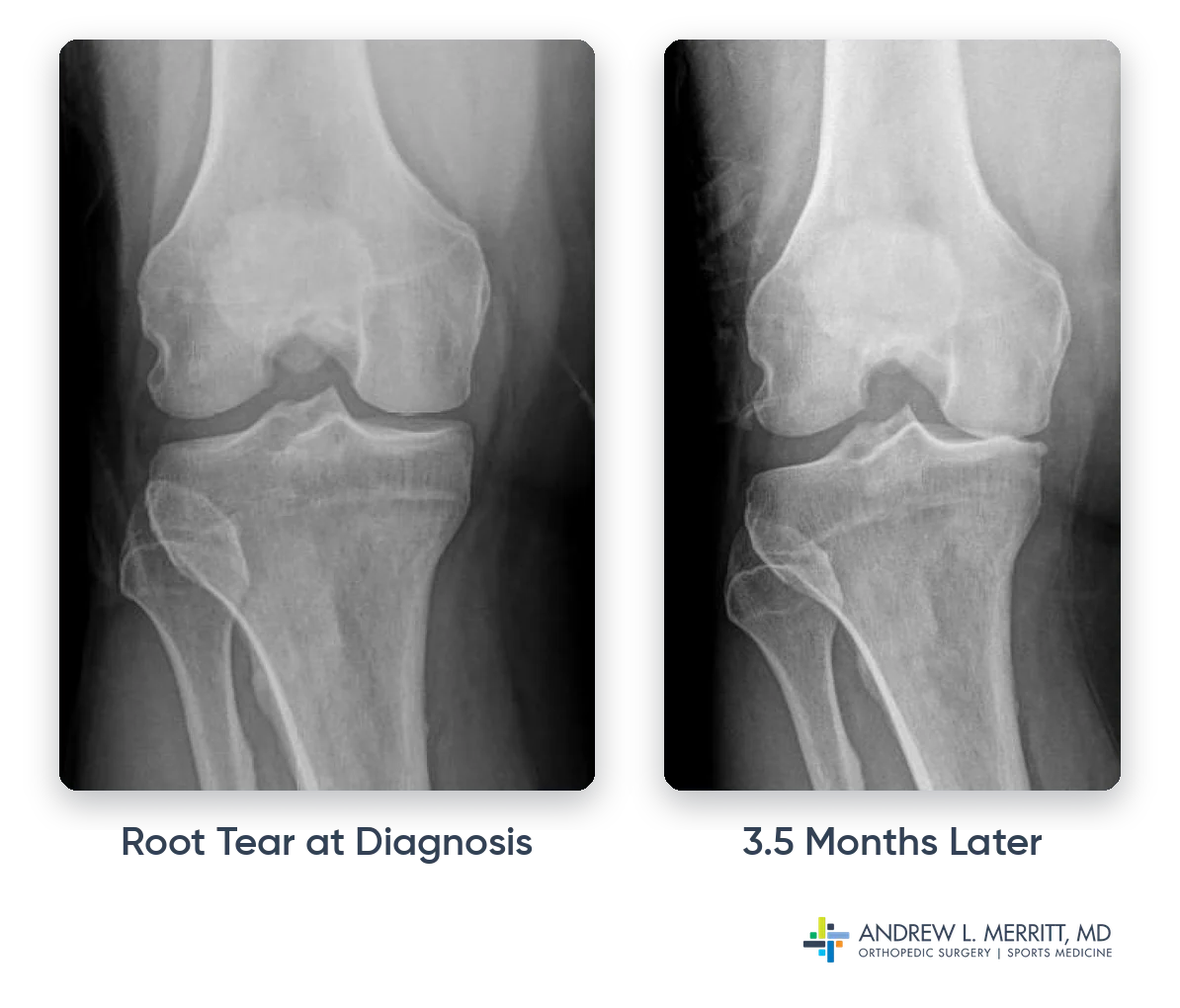
Root tears most commonly affect the posterior horn of the medial meniscus. They can occur from a sudden injury — a deep squat, twist, or pivot — or develop more gradually in patients with some underlying degeneration. Many patients recall a distinct pop followed by sudden pain and swelling. I see these injuries regularly in my practice and consider root repair one of the most important joint-preserving procedures I perform, because the consequences of leaving a root tear untreated are significant and well-documented.
In some cases, there is already too much arthritis, and bringing the meniscus back into the joint space is not possible. If this is the case, unfortunately a repair cannot be performed.

Video Education
Dr. Merritt has filmed several in-depth videos on Meniscus Root Repair surgery with the aim of helping patients understand the condition, the procedure, and what to expect during recovery.

Meniscus Root Tear
Repaired Meniscus Root
Treatment Options
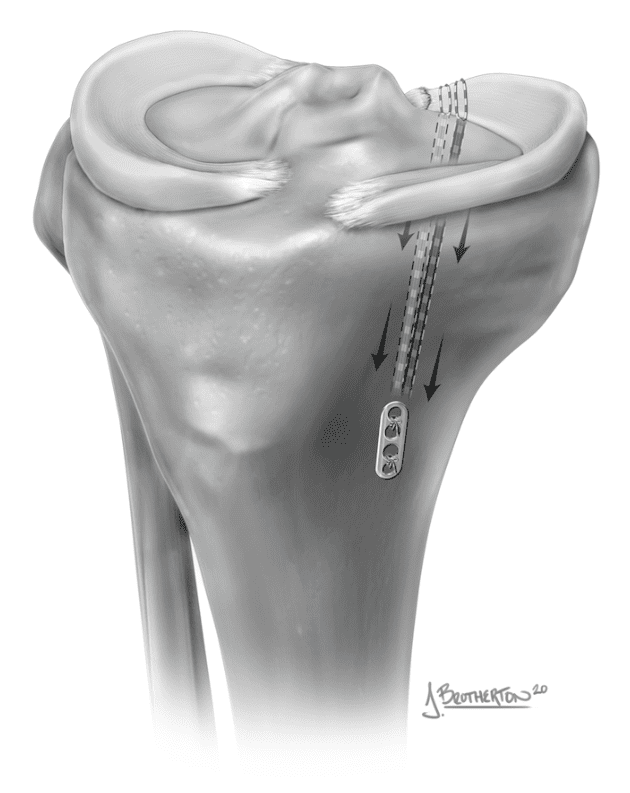
The goal of meniscus root repair is to reattach the torn meniscus root to its anatomic footprint on the tibia, restoring the hoop stress mechanism and allowing the meniscus to function normally again. This is fundamentally a joint preservation surgery — without repair, the affected compartment is at high risk for progressive cartilage loss and eventual knee replacement.
The procedure is performed arthroscopically. I place sutures through the meniscus root and pass them through a small bone tunnel in the tibia, pulling the root back down to its native attachment site and securing it against the bone. The repair relies on the meniscus root healing directly to the bone surface — a process called enthesis healing — which is similar to how an ACL graft heals inside a bone tunnel. This bone-to-tissue interface is the reason the postoperative protocol is more restrictive than a standard meniscus repair.
Not every meniscus root tear is a candidate for repair. The decision depends on the amount of existing cartilage damage, the patient’s alignment, and the overall condition of the knee. In patients with advanced arthritis or significant cartilage loss, a root repair may not change the trajectory of the joint, and other treatment options may be more appropriate. I evaluate each case individually with advanced imaging and an honest conversation about what repair can and cannot achieve. When the joint condition supports it, root repair offers a real opportunity to preserve the knee and delay or prevent the need for joint replacement.
Recovery after a meniscus root repair is the most restrictive of any meniscus procedure, and for good reason. The repair involves healing a meniscus-to-bone interface that is under direct stress every time you put weight through the knee. Protecting this interface during early healing is the single most important factor in a successful outcome.
For the first six weeks, you must be completely non-weight-bearing — no foot contact with the ground on the surgical side. Crutches carry all your weight during this period. Range of motion is also limited to 0 to 90 degrees. You will wear a hinged brace, unlocked from 0 to 90 degrees, whenever you are up on crutches and when you sleep; it can come off for your bending exercises and for resting in bed, but you must never bend past 90 degrees. I know six weeks of non-weight-bearing is demanding, but this is non-negotiable. Even partial weight-bearing during this window generates hoop stress forces that are transmitted directly to the repair site and can cause it to fail before healing has occurred.
During the non-weight-bearing period, physical therapy focuses on quad activation using techniques like neuromuscular electrical stimulation and blood flow restriction training to minimize muscle loss. After six weeks, you gradually transition to full weight-bearing over several weeks. Range of motion opens up, but loaded deep squatting and kneeling past 90 degrees are restricted until five months. Running begins around weeks 18 to 20 (about 4½ to 5 months) with my clearance, and full return to sport is anticipated at six months based on meeting strength and functional testing criteria.
The results of meniscus root repair are encouraging, particularly when compared to leaving the tear untreated. Studies show clinical success rates around 78 percent, with significantly less arthritis progression and dramatically lower rates of conversion to knee replacement compared to patients whose root tears were not repaired. For the right patient, root repair is a powerful joint preservation tool that can meaningfully change the long-term trajectory of the knee.
Recovery and Results
Meniscus Root Repair Recovery Timeline
Non-weight-bearing protocol — drag the slider or select the post-operative time to explore each phase
Surgery & Physical Therapy Resources
Discover detailed instructions and protocols to guide patients through Pre-Op, Post-Op and Physical Therapy from Dr. Merritt.
Related Articles
Read more from Dr. Merritt about meniscus root tears and repair.
Common Meniscus Root Repair Questions
Injury Information
A: Age alone does not disqualify someone from root repair. What matters is the condition of the cartilage and the overall health of the knee. Studies show that patients over 60 can achieve good outcomes from root repair when the joint condition is appropriate. I evaluate each case individually.
A: Without repair, the meniscus cannot distribute load, and the cartilage in the affected compartment takes on excessive stress. Research shows that unrepaired root tears have high failure rates with significant arthritis progression and up to a third of patients eventually needing knee replacement. If your joint condition supports repair, I strongly recommend it.
A: Most meniscus tears damage a portion of the meniscal body but leave the anchoring roots intact, so the meniscus can still function to some degree. A root tear disrupts the entire load-sharing mechanism. Research shows that unrepaired root tears lead to accelerated arthritis and high rates of eventual knee replacement. That is why I treat these as urgent joint preservation cases.
A: The meniscus root is the anchor point where the meniscus attaches to the shinbone. When this root tears, the entire meniscus loses its ability to distribute load properly. Biomechanically, a root tear is equivalent to having no meniscus at all, which is why it can lead to rapid cartilage damage if untreated.

Surgery Information
A: Studies report clinical success rates of approximately 78 percent. Compared to leaving root tears untreated or performing a meniscectomy, root repair shows significantly less arthritis progression and dramatically lower rates of conversion to total knee replacement. For the right candidate, the outcomes are compelling.
A: Pain after root repair is similar to other arthroscopic knee procedures — most patients find it manageable with our multimodal pain approach. The bigger challenge is the non-weight-bearing period, which requires patience and planning. Ice and elevation in the first week make a significant difference.
A: A meniscus root repair typically takes about 60 minutes. It is performed arthroscopically and you go home the same day.
A: The surgery is performed arthroscopically. I place sutures through the torn root and pass them through a small tunnel drilled in the tibia, pulling the meniscus root back to its anatomic attachment and securing it against the bone. The repair heals through a bone-to-meniscus interface, similar to how an ACL graft heals in a bone tunnel.
Post-Op Recovery
A: Physical therapy starts 5 to 7 days after surgery, usually 2 times a week, even during the non-weight-bearing period. Early therapy uses electrical stimulation and specialized techniques to keep your quad active without loading the knee. After six weeks, therapy progresses through weight-bearing, strengthening, and eventually sport-specific training. Most patients are in formal PT for three to five months.
A: Full return to sport including running, cutting, and pivoting is anticipated at six months. This requires meeting objective criteria: quad strength at least 90 percent of the opposite leg and passing hop tests. Deep squatting and kneeling are restricted until five months to protect the repair during final remodeling.
A: Desk work can often resume within one to two weeks if you can manage the commute and work setup on crutches. Jobs that require standing or physical labor will take longer — typically three to four months for light duty and up to six months for full physical demands.
A: For right knee surgery, you must be off crutches, out of the brace or with it unlocked, off narcotic pain medication, and able to brake hard. This is usually about eight to twelve weeks. For left knee surgery (automatic car), it is usually two to four weeks, once you are off narcotic pain medication. There is no set date, and it is not up to me to release you: the rule is that you must be a safe, unimpaired driver.
A: Yes. You will wear a hinged knee brace, unlocked from 0 to 90 degrees, whenever you are up on crutches and when you sleep, for at least six weeks. It can come off for your bending exercises and for resting in bed, but never bend past 90 degrees. The brace is typically weaned between eight and ten weeks as weight-bearing and quad control progress.
A: Weight-bearing begins at six weeks and is a gradual transition. You will start with partial weight on crutches and progress to full weight over two to four weeks as your quad strength and comfort allow. Most patients are walking without crutches by eight to ten weeks. No pool walking before six weeks; it can start once you begin putting weight on the leg, with my approval.
A: Every time you put weight through the knee, the meniscus generates hoop stress — and that stress is transmitted directly to the root attachment. Before the repair has healed to the bone (which takes about six weeks for initial stability), even partial weight-bearing risks tearing the repair apart. Six weeks of strict non-weight-bearing is the biological requirement for root repair healing.
See what other patients say about their experience.
You deserve to move freely again. We will help you take that step.
Call to book an appointment
(425) 291-1496