
Knee Arthritis and Total Knee Replacement
Arthritis of the knee is one of the most common causes of chronic joint pain and loss of mobility. The condition occurs when the protective cartilage that cushions the bones wears down over time, leading to inflammation, stiffness, and pain. The most common type is osteoarthritis, though rheumatoid and post-traumatic arthritis can also affect the knee.
As cartilage wears away, much like tire tread thinning down to nothing, bones begin rubbing together causing pain and limited motion. Early on symptoms may be mild, but as arthritis progresses, everyday activities like walking and climbing stairs become difficult.
Conservative treatments such as physical therapy, medications, injections, and bracing can help, but become less effective as the condition advances. When they no longer provide relief, knee replacement offers a long-term solution to restore function and quality of life.


Treatment Options
Initial treatment is often conservative and involves working on maintaining range of motion and strength around the knee. Patients often manage early and moderate arthritis for many years just from exercise, diet, and activity modification. In fact, with proper care of the knee, early arthritis is very tolerable and patients remain very active including golf, and pickleball, gym activities.
In clinic, we can discuss additional conservative options including oral medications and injections. Injections include hyaluronic injections (“gel injections”), cortisone, and PRP. Special braces called “unloader braces” can be used in specific types of arthritis and can be very effective in controlling pain and allowing patients to continuing working and athletics.
Ultimately, surgical treatment revolves around knee replacement to restore the articular surface in the knee joint. Knee replacement surgery involves removing the damaged portions of the joint and replacing them with metal and plastic components that mimic the natural shape and movement of the knee. There are two main types of procedures: total knee replacement and partial knee replacement. Both are discussed in the video below.
Find out more about Partial Knee Replacement.
Video Education
Dr. Merritt has developed an in-depth video on knee arthritis injury, treatment and overview to help patients better understand the condition, the procedure, and what to expect.
What Is a Total Knee Replacement?
A total knee replacement (also called total knee arthroplasty) is a surgery in which the worn-out cartilage surfaces of the knee are removed and replaced with metal and plastic components that recreate a smooth, pain-free joint surface.
The name is a bit misleading. My patients are often surprised to learn that the vast majority of the knee stays right where it is. Think of it as resurfacing rather than replacing. Only the damaged cartilage and a thin cap of bone underneath it, roughly 18 millimeters in total, are removed from the end of the femur and the top of the tibia. Three of the four major knee ligaments, all of the surrounding muscle and tendon, and nearly all of the bone remain untouched. The new surfaces are shaped to glide against each other the way healthy cartilage once did.
The implant I use is the DePuy cementless cruciate-retaining knee system from Johnson & Johnson. I offer advanced robotic-assisted total knee replacement with the DePuy VELYS system, and I choose robotic or conventional precision instruments based on what is best for your knee. Cementless means the components have a porous surface that your bone grows directly into over the first several weeks, creating a durable biologic fixation rather than relying on bone cement. Cruciate-retaining means the posterior cruciate ligament is preserved, which helps the knee feel more natural. This is a high-flexion, high-demand, newest-generation design from one of the most established implant companies in orthopedics.
The surgery itself takes about 1 to 1.5 hours, and the total time in the operating room is about 90 to 120 minutes. I perform it under spinal anesthesia with a regional nerve block, so most patients avoid general anesthesia and the nausea and grogginess that come with it. I also inject a long-acting pain medication mixture around the joint before closing. For the large majority of my patients this is an outpatient procedure at Proliance Surgery Center at Valley, and you go home the same day walking with full weight on the new knee. Patients with certain age or health considerations may have surgery at Valley Medical Center with a one-night stay.
Like any surgery, total knee replacement carries risks, including stiffness, infection, blood clots, numbness around the incision, and the possibility of the implant wearing out over time. Infection prevention is something I take seriously: skin disinfection starts five days before surgery, the surgical site is cleaned at five separate points, and the surgery center uses modern laminar-flow air exchange systems. For patients whose arthritis has progressed past what conservative care can manage, this is a reliable, long-term solution to get back to a comfortable, active life.

Knee Replacement Recovery Timeline
Drag the slider or select the post-operative time to explore each phase of your recovery
What surgery did you have?
Which part of your knee was replaced?
Surgery & Physical Therapy Resources
Discover detailed instructions and protocols to guide patients through Pre-Op, Post-Op and Physical Therapy from Dr. Merritt.
Related Articles
Read more from Dr. Merritt about knee arthritis treatment and total knee replacement.
Common Knee Arthritis and Total Knee Replacement Questions
Injury Information
A: Almost certainly yes, at least with older-style metal detectors. Modern total knee replacements contain cobalt chrome and titanium alloy components, and these will typically trigger metal detector screening at airport security. This is a permanent feature of your new knee — it does not change over time.
Here is what to expect: you will likely be pulled aside for additional screening, which usually means a handheld wand or a pat-down around the knee. TSA agents are very familiar with joint replacements, and this is a routine, quick process. You do not need a special card or letter from your surgeon — TSA does not accept these as bypass documentation in the US.
For international travel, the protocols vary by country. Some countries and airports may ask for documentation from your surgeon confirming the implant. It is worth having a letter from our office on file if you travel internationally frequently — just ask us and we will provide one.
The good news: this is a minor inconvenience, not a limitation. Travel — including active travel like hiking trips and ski vacations — is absolutely something I expect my patients to get back to after knee replacement.
A: Robotic-assisted knee replacement has become one of the most talked-about topics in joint replacement, and for good reason — it represents a potential improvement and the future of surgery. Yes, I do offer robotic knee replacement, and I use the DePuy Velys Robotic Knee Replacement system for total knee procedures.
Unfortunately we are not to the point of robots actually doing surgery. Instead robotic-assist is just a way to use a computer to help plan the cuts of the knee to fit the implant. All decision-making and cutting are still done by the surgeon. For this reason, robotic-assist is not automatically “better.” In fact, the cuts I do using the standard technique with precise cutting jigs seem to be the same and usually I prefer the standard technique. I have not noticed any clinical difference between total knees done with robotic-assist and conventional technique.
One exciting technological development for the future is Augmented Reality Knee Replacement. I am a designer for the NEXTAR Partial Knee system for Medacta, Inc., which uses augmented reality technology for partial knee replacement. This is still in the works, but the future is exciting as technology, AI, patients, and surgery all collide and present new opportunities.
If you are curious whether robotic replacement is right for you, we will discuss it in clinic. Not every patient requires or benefits equally from robotic assistance, and I will give you an honest assessment.
A: Modern knee replacements are designed to last a very long time, and the data is encouraging. With current implants and techniques, approximately 90-95% of total knee replacements are still functioning well at 15 years, and many go significantly longer. The highly cross-linked polyethylene (plastic) spacer I use wears at approximately 1mm every 20 years — which gives you a sense of how durable the modern materials are.
The two main reasons a knee replacement may eventually need revision are: mechanical loosening of the implant from the bone over time, and wear of the plastic spacer. Both of these risks are reduced considerably by the cementless fixation technique I use in most patients, which allows your own bone to grow into the implant and create a permanent bond.
What can affect longevity on your end: body weight, activity level, and bone quality all play a role. Higher-impact activities over decades put more cumulative stress on the implant. This does not mean you cannot be active — quite the opposite, staying active and strong is good for your replacement. It does mean that truly high-impact activities like running and jumping are worth discussing in terms of long-term implant health.
The other big risk is infection. These can happen in the short term or long term, but fortunately are very rare. The rate of an infection happening around the time of surgery is about 1 in 200-300 patients because we have such an extensive infection prevention program. Later in life, especially if you become unhealthy or your immune system becomes compromised, an infection in your body can spread to your bloodstream and into your knee. Again, this is rare, but remains a risk for needing additional surgery.
The bottom line: most patients who receive a knee replacement today should expect it to last them the rest of their life, particularly if they are over 60 at the time of surgery. For younger patients, we have that honest conversation about revision rates upfront. It is part of planning the right surgery for the right person at the right time.
A: This is one of the most common things I hear in clinic — patients in their 40s and 50s who are suffering with severe arthritis but holding off because they think they are too young. My honest answer: there is no magic age for knee replacement. The decision is driven by the severity of your arthritis, how much it is affecting your life, and whether conservative options have been exhausted.
The concern with doing knee replacement in younger patients has historically been implant longevity — if your replacement lasts 20-25 years, a 50-year-old may need a revision surgery later in life. This is a real conversation worth having. However, modern implants with advanced materials and cementless fixation are performing better than ever, and the data on longevity continues to improve.
What I tell younger patients is this: if your knee pain is limiting your ability to work, be active, and enjoy your life, and if conservative treatments are no longer helping, waiting is not protecting you — it is just delaying your quality of life. I treat a lot of active, younger patients who want to get back to skiing, hiking, and pickleball, and their outcomes are excellent.
If anything, younger patients tend to go into surgery in better overall health and bounce back faster. Age is one factor in the conversation, but it is not the deciding one. Come see me and let us look at the full picture.
A: Recovering from total and partial knee replacement is a coordinated effort between the patient, the physical therapist and the surgeon. This starts long before surgery. I believe proper nutrition is important before surgery and this is covered in my video on protein needs in surgical patients. Studies have shown that increasing protein intake prior to surgery speeds muscle recovery after surgery.
As always, “stronger into surgery equals stronger out of surgery.” With diligent work on strength and maintaining range of motion of the knee before surgery, and with that effort continued after surgery, we are well on our way to an excellent outcome. As your surgeon, I will promise that I perform a technically excellent surgery and match your anatomy with the knee replacement so that you have full range of motion at the conclusion of the surgery.
A: Both operations only remove a minimal amount of bone and cartilage in the knee. The difference lies in the surfaces being replaced. Total knee replacement replaces all surfaces of the joint while partial replacement targets only the damaged section when arthritis is limited. This is described in better detail and with pictures in the video above.
A: This is a great question and one I think about carefully with each patient. Injections — whether cortisone, gel (hyaluronic acid), or more advanced biologics like PRP — can be very effective at managing arthritis pain. They are a legitimate part of conservative treatment, and I use them regularly. If they are working well, keep doing them!
The reality is that they work best in the earlier stages of arthritis, and for many patients, their effectiveness gradually decreases as the arthritis progresses.
Here is the biological reality: injections treat symptoms — pain and inflammation — but they do not slow or reverse the underlying cartilage loss. As the arthritis becomes more severe and the cartilage wears away, there is simply less cushion left for the injection to work with. The relief becomes shorter-lasting, then minimal, then nothing.
My honest advice: if injections are still giving you several months of meaningful relief and you are managing well, keep using them — they are buying you quality time. But when you find yourself coming back more and more frequently for injections that are lasting shorter and shorter, that is a signal that the arthritis has progressed to the point where surgery is likely the better long-term answer.
The goal of all of this — injections, physical therapy, medications, and ultimately surgery if needed — is the same: get you back to doing the things you love with as little pain as possible. I will always be honest with you about where you are in that progression.
A: I tell people that surgery is indicated when “the right patient has the right problem, at the right time.”
The right patient: Healthy enough to go through surgery, risk factors are minimized, and body weight is appropriate, etc
The right problem: The pain is coming from severe arthritis and other causes of pain have been excluded. Ultimately knee replacement treats pain associated with cartilage and meniscus wear (arthritis).
The right time: Conservative treatment is no longer working and your pain is at a no longer tolerable level. The right time also includes consideration of your work schedule, availability of people to help you, and you are mentally in a good place to dedicate time and effort toward recovery.
A: Yes! Arthritis is often missed with the wrong type of xrays. In clinic at an orthopedic office, we have specific arthritis xray views that require the patient to be standing. These are more complicated to get, but without the right xrays the knee can look normal when in fact there is significant arthritis. Come see us anytime if you need a full workup and if there is no arthritis, we will work together to figure out the problem.
A: These are common symptoms of arthritis, but other issues with the knee also present with the symptoms. The diagnosis is confirmed with specific standing xrays.
Surgery Information
A: This is something I encourage every patient to think about well before surgery day, and it makes a real difference in how comfortable and safe your early recovery is. You are going to be moving around with a walker and limited mobility for the first couple of weeks — setting your home up in advance makes everything easier.
The most important things to address:
- Sleeping situation: Ideally, plan to sleep on the ground floor for the first 1-2 weeks to avoid stairs. If that is not possible, practice navigating your stairs before surgery so you have a plan and the technique down
- Trip hazards: Walk through your home and remove loose rugs, cords, and anything on the floor you could catch a walker on — falls are the biggest early risk
Kitchen and daily items: Set up the things you use most — medications, phone charger, TV remote, water bottle — at seated height so you are not bending or reaching awkwardly - Ice and elevation: Have your ice machine set up (if you are using one), pillows for elevating the leg, and a comfortable chair that allows you to get up and down without too much effort. A chair that is too low is harder than you expect in the first week
- Medications: Your prescriptions will be picked up by your family member during surgery. It is easiest to get them at the pharmacy at our surgery center.
Physical therapy appointment: This should be booked before surgery for 5-7 days after your procedure — do not wait until after surgery to schedule it
If you have a dog that jumps or a home with a lot of stairs, think through those logistics in advance. A few hours of home preparation before surgery saves a lot of frustration in the first week after.
A: A couple of days before surgery you will receive a call from the nursing staff to explain your check-in time and when to stop eating and drinking. Check in at the front desk of our surgery center at the time you were told. You do not need to be earlier. The friendly front desk staff will verify your name and the procedure and have you sign some documents related to getting surgery. You will then be brought back to the “Pre-Op” area with your family where our skilled nurses will help you get changes, shave your leg, start an IV, and go over your medications, allergies, and health history. You will meet with me before surgery and I will review the surgery and together we will identify the correct procedure and knee being treated. Anesthesia will meet with you and review the planned anesthesia. When the operating room is ready, you will say goodbye to your family and walk back to the operating room with one of our nurses. The nurse will introduce you to everyone in the room and you will lay onto the operating room table. Anesthesia will be given and you will not remember anything until you are in the recovery room.
While in surgery, your family will pick up your post-operative medications at the pharmacy next to the Surgery Center. If you are under 18, one family member needs to stay at the surgery center for the whole-time during surgery. In this case, medications can be picked up on your way out.
In the recovery room you will be monitored by the nurses until you are awake and stable and then be transferred to a room where you can again be with your family. You will have some crackers and juice or soda and they will make surgery you are comfortable and give you pain medications as needed. Once you feel ready, you will change into your street clothes and be wheeled to your car.
A: Modern implants and surgical techniques are very successful in the goal of relieving pain and improving function for people with knee arthritis. Great advancements have been made in cartilage restoration and preventing the development of arthritis and this is something I am very involved in treating.
Unfortunately, once arthritis is severe, the surgical solution remains partial or total knee replacement. Current implants look similar to old replacements, but the advancements are more subtle. Cementless options for fixation, more advanced materials, improved radii of curvature to match the normal knee, better surgical techniques to better match the patient’s anatomy, and infection control measures have all advanced drastically. Robotic surgery is here and we can discuss this as an option, but the results have struggled to show significant improvement in functional outcomes and there are some downsides to consider.
Otherwise, the implants are not going to drastically change in the next 10 years and progress will be incremental. So if you are struggling now, then now is a great time to get fixed. The future is here, now!
A: In the majority of cases, I do not cement the implant. If the bone is strong and there are no cysts that prevent strong initial fixation, a cementless implant is used. This allows the bone to grow into the implant and make a permanent attachment. The goal of this technology is to decrease the risk of loosening over time.
A: In short, metal and plastic. I went to college for Engineering and initially studied Materials Engineering, so this answer does not do justice. So if interested: The cementless tibia is made of Titanium Alloy with a 3-D printed titanium lattice that mimics the normal bone architecture which allows the bone to firmly attach. The femur is made of Cobalt Chrome Alloy. The “plastic” spacer is polyethylene that is high molecular-weight and highly cross-linked which makes it very wear resistant. The wear rates of this advanced material is about 1mm per 20 years.
A: I use the Johnson & Johnson DePuy implant for knee replacement. In most cases, I use the cementless cruciate retaining knee replacement. This is a very high quality and rigorously tested implant by one of the most reputable implant companies in the world.
Learn more here: https://www.jnjmedtech.com/en-US/product/attune-knee-system
A: Knee replacement is done under spinal anesthetic and a regional block to control pain. This lowers the amount of pain and side effects of a general anesthetic. During the surgery I inject a long acting pain medication “cocktail” around the joint and in the capsule as an additional aid to early pain control.
A: Yes, this is a covered procedure by insurance programs. In fact, here at Proliance Orthopedic Associates we are in the top tier with most insurance companies because of our excellent results, low complication rate and cost-effective treatment. This means we often have lower cost to the patient than other facilities. The cost will depend on your plan and deductible status but we will give you a very accurate financial summary of what to expect before surgery.
A: Partial knee replacement takes about 45 minutes, about 60 to 75 minutes in the operating room. Total knee replacement takes about 1 to 1.5 hours for the surgery. With anesthesia setup and thoroughly cleaning your leg in the sterile operating room, the total time is about 90 to 120 minutes.
Post-Op Recovery
A: Kneeling is one of the most common concerns patients bring up, and honestly it is one of the trickiest parts of recovery. The short answer is: most patients can eventually kneel, but it often feels uncomfortable or unusual even in patients with an otherwise excellent outcome.
The difficulty with kneeling is not a structural problem with the implant — the replacement itself is perfectly capable of handling the position. The discomfort usually comes from pressure on the skin and soft tissue around the incision, and from the general sensitivity that persists around the front of the knee for many months after surgery.
Here is what I tell patients: give it time. Many patients who cannot comfortably kneel at 6 months find that it becomes much more manageable at 12 months as the scar tissue matures and sensitivity decreases. Using a padded kneeling pad is helpful. Kneeling on a softer surface is more comfortable than a hard floor.
If kneeling is important to you — whether for gardening, religious practice, a trade occupation, or any other reason — tell me before surgery. It is part of how I think about the surgical plan and part of what we set realistic expectations around together.
A: Most of recovery from knee replacement goes smoothly, but it is important to know the difference between normal post-operative discomfort and something that needs attention. Here is what to watch for:
Call our office right away if you notice:
- Increased redness, warmth, or swelling around the incision that is getting worse rather than better — especially beyond the first week
- Drainage from the incision that is cloudy, thick, or foul-smelling
- Fever above 101.5°F — a mild low-grade temperature in the first couple of days is normal; a higher persistent fever is not
- Pain that is worsening significantly after an initial period of improvement
- Sudden increase in knee swelling well after the first week
Signs of a blood clot — call our office or go to urgent care / ER:
- New calf pain, especially with calf tenderness when your foot is flexed upward
- Significant swelling specifically in the calf that is different from your knee swelling
- Sudden shortness of breath, chest pain, or rapid heart rate — these are emergency symptoms. Call 911.
What is normal and not a cause for concern:
- Bruising down the thigh and lower leg and around the knee in the first 1-2 weeks — this is old surgical blood tracking by gravity. This is NOT a sign of a blood clot.
- Clicking or clunking sounds in the knee — very common as the new implant settles
- Numbness around the outside of the incision — the small skin nerves are disrupted during surgery and sensation usually returns over weeks to months
- Swelling that fluctuates, especially after more activity — expected for the first several months
When in doubt, call. I would always rather hear from you and reassure you than have you wait on something that needs attention.
A: Almost always the answer is no. In fact, 90% of my patients go home the same day as the surgery. Knee replacement at our facility is performed as an outpatient procedure, meaning patients go home the same day as surgery. This is something I take pride in and have specifically designed our program to support.
Going home the same day is not cutting corners — the research actually shows that patients who recover at home do at least as well, and in many cases better, than those who go to a skilled nursing or rehab facility. You sleep better in your own bed, you are in a familiar environment, and you are not exposed to the infection risks that come with inpatient facilities.
What makes same-day discharge safe and successful is preparation. We set you up with everything you need before surgery — physical therapy is done at our facility before you leave and then starts within the first week, pain management is carefully planned, and we give you clear instructions for what to do and what to watch for at home. You are not on your own; you are supported.
The patients who may need additional support are those who live alone with no one to help them or have significant medical complexity. We discuss this proactively and make a plan that fits your situation. But for most healthy, well-prepared patients, going home the same day is not only possible — it is the preferred approach.
A:
- Verify check-in time and follow the instructions on when to stop eating and drinking. You should have been prescribed Physical Therapy at the time of your clinic appointments before surgery.
- Make sure you have called and made an appointment with Physical Therapy for 5-7 days after surgery.
- Wear comfortable clothes that are easy to put on (sweatpants work well)
- Do not put on perfume or lotion on your skin
- Avoid jewelry or it will need to be removed before surgery
- If using an ice machine, make sure you have ice ready to be used at home
- It is recommended to have clean sheets in your bed and laundry done with clean and comfortable clothes
A: Infections in knee replacement are rare. In properly selected and optimized patients in our clinic, the rate is about 1 in 200-300 patients. This is far lower than the national average because we are diligent and obsessive about sterility and cleanliness. Unfortunately, infections can occur, but these are almost always from inside the patient. If a patient gets pneumonia or a urinary tract infection or septic, the bacteria in the bloodstream can find its way to the knee joint and cause a serious infection.
A: This is a battle that we win by a million small steps. This starts with your health optimization with medication management, diabetes control, and general optimization for surgery. Starting 5 days before surgery you start to disinfect the knee. On the day of surgery we clean the surgical area at five different points, in the pre-op area, three times in the operating room, and once after the surgery is performed. Our operating rooms at the surgery center are equipped with the most modern laminar flow air exchange and they NEVER have cases with any infection. This means that no patient with an active infection has ever been inside the operating room. Finally, we close the incision with dissolving stitches, skin glue and mesh tape, and a waterproof antimicrobial dressing.
A: Can I ski, hike, or play pickleball?
This is one of my favorite questions to answer because the answer is better than most people expect. The goal of knee replacement is not just to get you walking without pain — it is to get you back to doing the things you love. For most of my patients in the Pacific Northwest, that means hiking, skiing, golf, biking, and pickleball.
Here is the general framework for return to activities:
- Walking without restriction — within days of surgery
- Stationary bike — within 2-3 weeks
- Golf and swimming — typically by 6-8 weeks
- Hiking on flat to moderate terrain — 2-3 months
- Skiing, pickleball, doubles tennis — typically 3-4 months with good rehab
- High-impact running and jumping — generally not recommended long-term due to implant wear
The activities I encourage patients to be thoughtful about long-term are sustained high-impact ones — repetitive running and jumping put more cumulative stress on the implant than lower-impact activities. But skiing, hiking, cycling, golf, pickleball, swimming, and similar activities are all appropriate and are the exact reasons we are doing this surgery.
I design the surgery with your activity goals in mind. The implant sizing and alignment, the surgical technique, and your rehab program are all tailored to help you get back to the life you want. Tell me what you love to do — that is part of planning your care.
A: While an artificial joint won’t feel the same as a natural one, most patients experience significant pain relief and improved motion. I tell patients that an “excellent” result is a knee that feels 70-80 the same as a normal knee. Since a plastic and metal knee has less cushion than a normal knee, the knee can feel different but the vast majority of patients are happy with the results and pain relief.
A: Recovery is a progressive endeavor. Some patients come into surgery in excellent shape and with great muscle control and flexibility and their recovery is often quicker and easier. On the other hand, some patients often come into surgery deconditioned because the knee pain has caused them to stop being active and working out. For this reason, timelines of recovery are variable. In general, you are walking the day of surgery with the use of a walker.
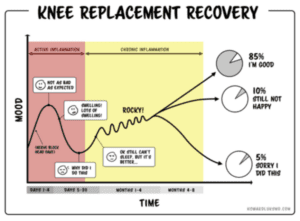
Physical therapy starts within a week after surgery and generally is done two times a week. During this time, you will regain quad control and strength. Most patients move from the walker to a cane around weeks 2 to 3 and walk with no assistance by 4 to 6 weeks. By 6 weeks most patients feel that they are “better than before surgery” but still have swelling, pain, and difficulty sleeping.
Activities continue to progress as pain and strength return and people often start playing golf, hiking, and working out more strenuously between 6 weeks and 3 months. With hard work, patients continue to improve for a full year after surgery as strength and stamina increase.
You deserve to move freely again. We will help you take that step.
Call to book an appointment
(425) 291-1496