
Cartilage Transplant with Osteochondral Allograft
An osteochondral allograft (OCA) is a cartilage transplant that replaces a damaged area of the knee’s joint surface, and the bone underneath it, with a size-matched plug of cartilage and bone from a donor. “Osteo” means bone, “chondral” means cartilage, and “allograft” means the tissue comes from a donor. Unlike most cartilage repairs, it is done in a single surgery.
My typical OCA patient has a cartilage lesion with injury to the underlying bone. For example, this can be an OCD lesion (osteochondritis dissecans, where a piece of bone and cartilage separates from the end of the bone) or an impaction fracture from an ACL injury that damaged the cartilage and the bone below it. OCA is also a good salvage operation after a previous MACI or microfracture when the underlying bone has been injured.
Since an OCA transplants cartilage and bone together, the cartilage is already firmly fixed to its bone. If there is concern about delamination in the knee, where cartilage is peeling away from the bone underneath, this surgery avoids that risk because it transplants cartilage that is already bonded to bone. We just have to get the bone to heal, and the cartilage is already attached.
Patients with these injuries usually have a deep ache in the knee, swelling after activity, and sometimes catching or locking from a loose piece. An MRI is needed to see the size and depth of the damage, and it is also how we measure the knee to find a donor graft that fits.

Video Education
Dr. Merritt has developed an in-depth video on Advanced Cartilage Treatment Surgery Information. This video helps patients understand the condition, the procedure, and what to expect.
Treatment Options
A cartilage and bone defect does not fill in on its own, and it tends to get larger over time. Small, stable lesions can sometimes be managed with physical therapy and activity changes, and some young OCD lesions heal with protected weight bearing. When the lesion is symptomatic, large, or involves the bone, an osteochondral allograft is one of the most reliable ways to restore the joint surface.
In surgery, I make an incision over the damaged area, core out the injured cartilage and bone down to healthy, bleeding bone, and press-fit a matching cylinder of donor cartilage and bone into the hole so its surface lines up with the cartilage around it. The surgery takes about 1 to 1.5 hours under general anesthesia with a nerve block, and you go home the same day from the Proliance Surgery Center at Valley or Valley Medical Center in Renton.
An OCA example: a large, deep OCD lesion on the end of the thigh bone
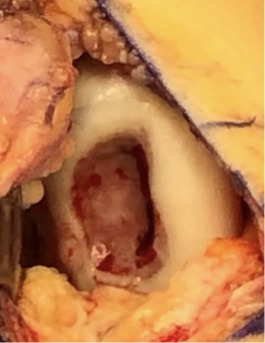


There are situations where both an OCA and MACI are possible. In that case, we look at the overall patient factors and decide which surgery is preferable. An osteochondral allograft tends to be slightly more reliable because it heals bone to bone, and in patients in their 30s and 40s it is often the preferred route. It remains a good option for focal injuries into the 50s in the right setting.
MACI keeps your own tissue and does not disturb the bone, which makes it a good fit when the bone is healthy, especially on the kneecap and in the groove, where the curves are hard to match with a plug.
Donor tissue is heavily screened for any infectious disease that could be passed to the patient. We match the size and shape of the donor graft to your knee using MRI measurements so that we get a good fit. Because of this, there is a wait to find a graft that matches, and that can often take 2 to 3 months. In larger patients it can be even longer, because we cannot use a graft that is too small for their knee.
As with any cartilage surgery, the rest of the knee has to be in good shape for the graft to last. A torn ligament is reconstructed and alignment is corrected at the same surgery when needed, which is why an OCA is often combined with an ACL reconstruction, an osteotomy (HTO or DFO), or a tibial tubercle osteotomy (TTO) for the kneecap.
Recovery and Results
Because the graft heals bone to bone, recovery after an OCA is faster than after a cell-based repair like MACI. The plan below is for a graft on the end of the thigh bone (femoral condyle); kneecap grafts and grafts combined with an osteotomy or ACL reconstruction have their own guides.
The first two weeks
Weeks 0 to 2
Most of this stage is about protecting the graft, controlling swelling, and keeping the knee straight.
- Weight bearing: Toe-touch only (about 10 to 15 pounds, for balance), with crutches for every step, even when the knee feels good.
- Brace: Hinged and unlocked for walking from day 1. Take it off for sleep, bending exercises, and showering.
- Swelling: Ice 20 minutes on and 20 minutes off, keep the leg up, and rest with a pillow under the calf, never under the knee. Pain and swelling peak around days 2 and 3.
- Exercises: Quad sets and ankle pumps every waking hour, straight-leg raises, and gentle bending with the brace off. The goal is 90° by 2 weeks, without forcing it. No CPM machine is needed.
- Therapy: Physical therapy starts 5 to 7 days after surgery, 2 times a week, with electrical stimulation to wake up the quadriceps.
- Medicines: Aspirin 81 mg twice a day for 6 weeks to lower the risk of blood clots, and no anti-inflammatory medicines. Tylenol on a schedule for the first 2 weeks; most people are off narcotics within 1 to 2 weeks.
- Milestones: Showering starts at 48 hours with the incisions covered, and the stitches dissolve on their own. Your 2-week visit checks the incisions and your motion. Desk work or school is often possible around 2 weeks if you can keep the leg up.
Protect the graft
Weeks 2 to 6
You are still toe-touch weight bearing on crutches while the donor bone starts to heal into yours.
- Motion: Keep building your bending. The stationary bike starts once you reach about 100°, usually at 4 to 6 weeks.
- Exercises: Straight-leg raises in all directions, hamstring curls, and hip and calf work, all while sitting or lying down.
- Pool: Pool walking at 4 to 5 weeks once the incisions have healed and I have cleared it. No baths, pools, or hot tubs before 4 weeks.
- Avoid: No standing exercises, squats, or lunges, and no partial weight on the leg before week 7.
Adding weight
Weeks 7 to 12
Weight is added once your quadriceps control is good.
- Crutches: Two crutches, then one, then none, usually by 8 to 10 weeks.
- Brace: Stops once you are off crutches with good quadriceps control.
- Medicines: Aspirin stops at 6 weeks, and we talk about restarting anti-inflammatories.
- Exercises: Weight shifts, light leg extensions, mini squats (to 60°, then 90° by week 12), leg press, 4 to 6 inch step-ups, calf raises, and balance work. The elliptical starts once you are off crutches.
- Avoid: No running, jumping, or impact.
Strength and running
Weeks 13 to 16
Strengthening gets harder and impact starts gradually.
- Exercises: Deeper squats, single-leg leg press, step-downs from 4 up to 8 inches, and balance board work.
- Plyometrics: Two-leg jump-and-land drills from weeks 13 to 14, building to single-leg hops, plus light agility work like ladders and side shuffles.
- Running: Running on flat ground usually starts at 14 to 16 weeks, once you pass the 8-inch step-down test with good mechanics.
- Goal: Quadriceps strength at least 80% of the other leg.
Return to sport
Months 4 to 6
Sport-specific training builds toward a full return. Waiting until 6 months makes sure the graft has fully incorporated.
- Running: Walk-jog intervals building to continuous running, adding distance before pace.
- Cutting: Cutting, jumping, and agility drills start no earlier than about 5 months (22 weeks), then sport-specific training.
- Testing: Strength testing and single, triple, crossover, and timed hop tests.
- Return to sport: Usually after 6 months, once quadriceps strength and hop tests are at least 90% of the other leg, you can run 20 minutes without pain or swelling, and I have cleared you.
A well-healed osteochondral allograft with good rehabilitation is expected to return to cutting and pivoting sports. This is generally delayed until the 6-month mark to make sure the graft has fully incorporated, but after that point we do not have any more restrictions on returning to sports. The ability to fully get back to cutting and playing sports often depends more on the other conditions in the knee than on the graft itself. The success of grafts fully incorporating and getting people back to sports is very high, and this is a well-tested and well-proven procedure.
In a long-term study of femoral condyle allografts, 82% of grafts were still working at 10 years. In a review of athletes treated with OCA, 72% returned to sport, and 84% of those returned at the same or a higher level.
I ask you not to take anti-inflammatory medicines (ibuprofen, naproxen, meloxicam, celecoxib, or Voltaren gel) for 7 days before and 6 weeks after surgery, because they can slow bone and cartilage healing.
Surgery & Physical Therapy Resources
Discover detailed instructions and protocols to guide patients through Pre-Op, Post-Op and Physical Therapy from Dr. Merritt.
Related Articles
Read more from Dr. Merritt about cartilage transplants and restoration.
Common Osteochondral Allograft Questions
Injury Information
A: When the bone under the cartilage is damaged, or there is concern about cartilage peeling off the bone, I lean toward an allograft. When the bone is healthy and the defect is contained, especially on the kneecap or in the groove, MACI is often the better fit. When both are possible, we choose together based on your age, activity, and the rest of your knee.
A: The best candidates have a focal cartilage injury that also involves the bone underneath, such as an OCD lesion, an impaction injury from an ACL tear, or a failed earlier cartilage repair. The knee needs to be stable and well aligned, or be made that way at the same surgery. It is not a treatment for widespread arthritis.
Surgery Information
A: Physical therapy before surgery to strengthen the quadriceps and get the knee moving well makes recovery easier, and so does good nutrition. An ice machine makes the first weeks much easier.
A: The main risks are stiffness, infection, blood clots, numbness around the incision, ongoing pain and swelling, the graft not healing to the bone, and the need for more surgery. Following the toe-touch rule for the full 6 weeks protects the graft while the bone heals.
A: The graft has to match the size and curve of your knee, which we measure on your MRI. Finding a matching donor often takes 2 to 3 months, and it can take longer for larger patients because the graft cannot be too small.
A: Donor tissue comes from accredited tissue banks and is heavily screened and tested for infectious diseases. The risk of passing on an infection is extremely low, and you do not need anti-rejection medicines.
A: It is a transplant of donor cartilage with a thin cylinder of bone attached. The plug is shaped to match your knee and press-fit into the damaged area, so you get a fully formed cartilage surface right away and only the bone has to heal.
Post-Op Recovery
A: In a long-term study of femoral condyle allografts, 82% were still working at 10 years. How long a graft lasts depends a lot on the rest of the knee, including alignment, the meniscus, and ligament stability.
A: Running usually starts at about 14 to 16 weeks, and return to cutting and pivoting sports is generally at 6 months once the graft has incorporated and you pass return-to-sport testing. When an osteotomy is part of the surgery, the timeline is longer, usually at least 9 months.
A: If your left knee was operated on and you drive an automatic, usually about 4 to 6 weeks, once you are off narcotic pain medicine. For the right knee it is usually about 10 to 12 weeks, because you need to be off crutches, out of the brace, off narcotic pain medicine, and able to brake hard.
A: For a graft on the end of the thigh bone, you are toe-touch weight bearing for 6 weeks and usually off crutches by 8 to 10 weeks.
Studies Cited
- Levy YD, Görtz S, Pulido PA, et al. Do Fresh Osteochondral Allografts Successfully Treat Femoral Condyle Lesions? Clin Orthop Relat Res. 2013. PubMed
- Touhey DC, Beady ND, Tartibi S, et al. Return to Sport in Athletes After Osteochondral Allograft Transplantation: A Systematic Review. Am J Sports Med. 2025. PubMed
See what other patients say about their experience.
You deserve to move freely again. We will help you take that step.
Call to book an appointment
(425) 291-1496