
Hip Arthritis and Replacement
If your hip hurts, you know it. Not the vague achiness of a tired muscle — this is pain that interrupts your sleep, makes you dread getting up in the morning, and quietly steals the things you love most. The hike you used to take on weekends. Bending down to pick up a grandchild. Getting through a round of golf without gritting your teeth on every step.
Hip arthritis is one of the most common reasons people seek orthopedic care, and it is also one of the most treatable. When conservative measures stop working, total hip replacement — which I perform through a muscle-sparing, minimally invasive anterior approach — is among the most reliable procedures in all of medicine — with over 90% of patients reporting dramatic pain relief and a meaningful return to activity. For most of my patients, the hardest part isn’t the surgery. It’s deciding to stop living around the pain and do something about it.
This page walks you through everything you need to know: what’s happening inside your hip, what we can do before surgery, what the procedure involves, and what your recovery will look like week by week. My goal is that by the time you finish reading, you feel informed, prepared, and ready.

Video Education
Dr. Merritt has developed an in-depth video on hip arthritis injury, treatment and overview to help patients better understand the condition, the procedure, and what to expect.

Treatment
Surgery is never the first step. Before we discuss hip replacement, I want to make sure we’ve given non-surgical options a real chance. For many patients — especially those with early or moderate arthritis — these measures can provide meaningful relief for months or even years.
For a full guide to these options, see Nonoperative Treatment of Hip Arthritis.
Staying active is counterintuitive for most people in pain, but it’s one of the most important things you can do. Strong core and hip muscles support the joint and reduce the load on the arthritic surfaces. Low-impact activities like walking, cycling, and swimming are ideal.
Maintaining a healthy weight is also meaningful — every pound of body weight translates to roughly three to four pounds of force across the hip joint during walking.
This doesn’t mean pushing through severe pain. It means finding the right level of activity that keeps you moving without aggravating the joint. A physical therapist can help you build a targeted strengthening program.
Over-the-counter anti-inflammatory medications (NSAIDs) like ibuprofen (Advil, Motrin), naproxen (Aleve), or meloxicam can reduce joint inflammation and provide meaningful pain relief. Tylenol (acetaminophen) is another reasonable option, particularly for patients who can’t tolerate NSAIDs due to stomach, kidney, or cardiovascular concerns.
Supplements such as turmeric and fish oil have some evidence for anti-inflammatory effects, though the data is more limited. They are generally safe and worth trying if you’re interested in additional options alongside standard medications.
Cortisone (corticosteroid) injections remain the most effective injection option for hip arthritis. They can provide weeks to months of significant pain relief, and while they don’t treat the underlying arthritis, they can be a useful bridge — especially if you’re trying to get through a specific event before surgery.
PRP (platelet-rich plasma) and stem cell injections are increasingly popular topics. The honest answer is that the evidence supporting these for hip arthritis remains mixed, and the cost is generally not covered by insurance. I discuss these with each patient individually, but I want to be straightforward: for significant arthritis, cortisone is still the most proven tool in the injection toolkit.
Injections can be repeated, but their effectiveness typically diminishes over time. When you’re getting injections every few months just to get by, that’s often a sign that surgery is worth a serious conversation.
Physical therapy doesn’t reverse arthritis, but it can meaningfully improve function by strengthening the muscles that support the hip joint. A well-designed program can reduce pain levels and delay surgery. I encourage patients to work with a physical therapist early — not just after surgery, but before it.
What Is a Total Hip Replacement?
A total hip replacement (also called total hip arthroplasty) is a surgery in which both worn-out sides of the hip joint are replaced. When we first meet and pursue nonoperative management, patients often ask me how they will know when it is time for surgery. I often tell them that it becomes very obvious. At first, the decision of when they will need surgery seems theoretical and uncertain, but generally what they find is that their pain and function decrease to the point where the answer becomes very obvious. The time to switch from nonoperative management to surgery is when conservative treatment is no longer allowing you to do the activities that you want in life.

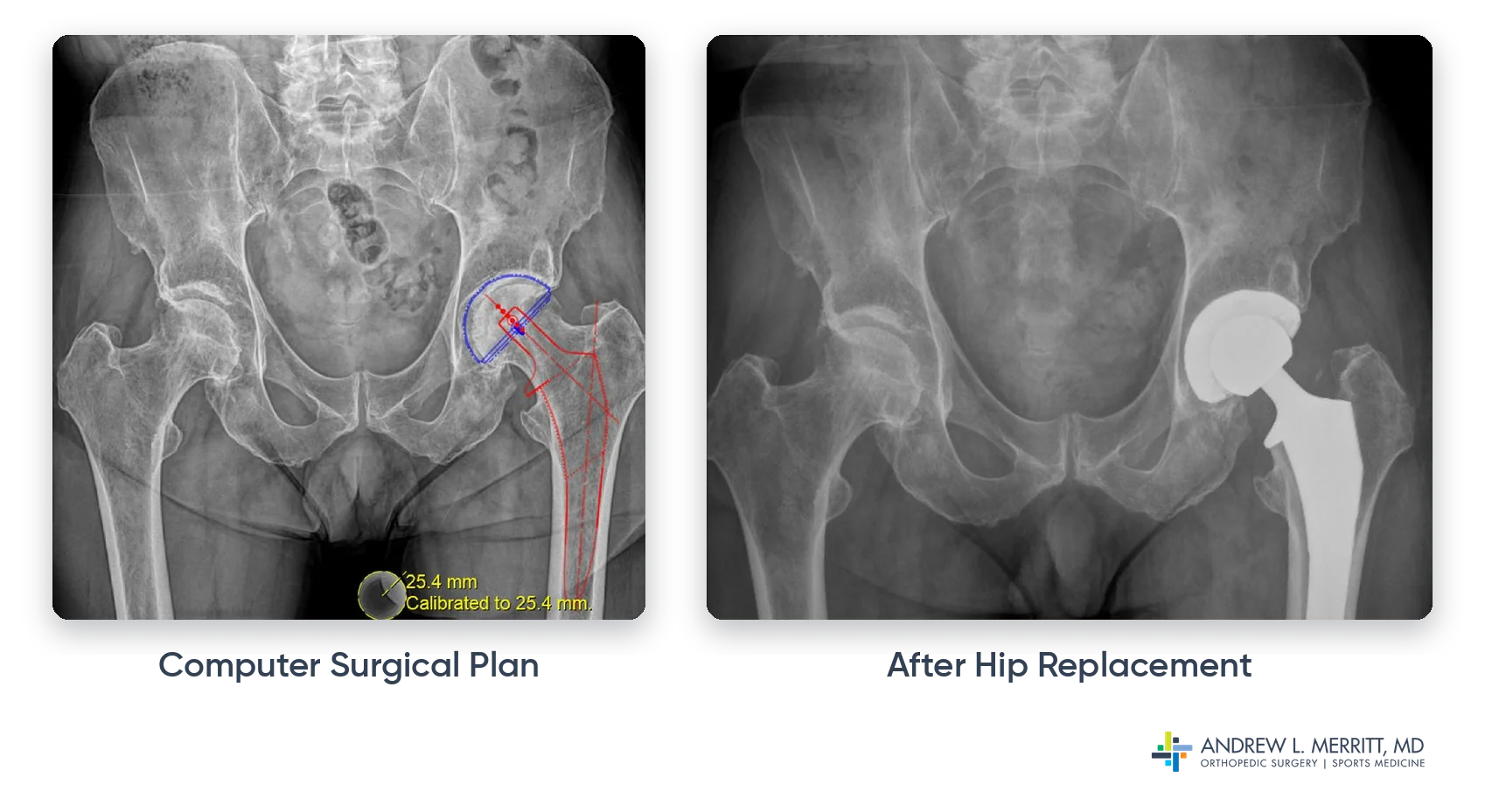
The hip is a ball and socket joint. During surgery the femoral head (ball) is removed and replaced with a ceramic ball that sits on a titanium stem inside the femur (thigh bone), and the acetabulum (socket) is lined with a titanium cup and a highly crosslinked, wear-resistant polyethylene (medical-grade plastic) liner. Both titanium parts are cementless and press-fit with a textured surface so that your bone grows into them over the first several weeks. The surrounding muscles and most of the hip capsule are left in place.
I use the Johnson & Johnson DePuy ACTIS cementless stem, Affixium cup and ARTICUL/EZE ceramic head. I chose this implant because of its cementless fixation to the femur and acetabulum, its long track record of excellent results, and a well-established implant company. In addition, there are multiple options for sizes and shapes so that, with preoperative templating and the use of computer technology, it can be fit to a large variety of hip anatomy. It is nice to have one implant company that offers such a large selection of options to match each patient’s anatomy.
Muscle-Sparing Anterior Approach
I perform every total hip replacement through the muscle-sparing, minimally invasive anterior approach. This means I reach the hip through the front, working in the space between the muscles instead of cutting or detaching them. The risk of dislocation is much lower than with the traditional posterior or lateral approach (well under 1%), and for this reason there are no rules about sitting in low chairs, bending forward to tie your shoes, or crossing your legs. The one restriction is no bridging exercises (lying on your back and lifting your hips) for six weeks while the front of the capsule heals.
I have had many patients who had the posterior approach done elsewhere on their first hip and the anterior approach done by me on the second side. The general feeling is a much faster recovery, much less pain, and getting off the walker and off the cane sooner. This is because we do not cut any muscles in the process of doing this operation, and it is minimally invasive. My total hip replacement outcomes show this as a consistently higher functional outcome compared to the national benchmark. The anterior approach takes specialized training and a dedicated surgical table that lets me position the leg precisely throughout the operation.
The Day of Surgery
The surgery takes about 60 minutes. It is done under spinal anesthesia with a regional nerve block, so most patients avoid general anesthesia and the nausea and grogginess that come with it, and I inject a long-acting pain medication mixture around the joint before closing. I do about 85% of my hip replacements as an outpatient, with same-day discharge from Proliance Surgery Center at Valley, so you walk before you leave and sleep in your own bed that night.
To go home the same day, patients need to be medically optimized by getting their medical problems under good control with their primary care doctor, do physical therapy before surgery, and have reliable help at home. There is no set age cutoff, and we have done many people in their 80s and even 90s as an outpatient. A medical team reviews every patient along with the primary care doctor to guide us on who should not be done as a same-day discharge, and every patient is also reviewed by anesthesia. Patients who need it have surgery at Valley Medical Center with a one-night stay.
Risks
Like any surgery, total hip replacement has risks. These include infection (about 0.5% with modern prevention protocols), blood clots, a difference in leg length, nerve injury that is usually temporary, loosening of the implant over time, a fracture around the implant, and dislocation. A small patch of numbness on the outer thigh is common and usually fades over 6 to 12 months. Infection prevention starts five days before surgery with a skin disinfection protocol that we go over at your pre-operative visit.
Hip Replacement Recovery Timeline
Drag the slider or select the post-operative time to explore each phase of your recovery

Results
Total hip replacement has one of the highest satisfaction rates of any elective surgery in
medicine. The data consistently shows:
- More than 90% of patients report dramatic reduction in hip pain after surgery
- More than 90% of patients report a significant improvement in quality of life
- Modern implants are designed to last 20–30 years in appropriately active patients; most last a lifetime
- The anterior approach is associated with lower dislocation rates and faster early recovery
compared to traditional approaches - Outpatient (same-day) hip replacement has been shown to be safe and effective for appropriately selected patients, with complication rates comparable to inpatient surgery
For my own numbers, including patient-reported function compared with the national benchmark, see Total Hip Replacement Outcomes.
Surgery & Physical Therapy Resources
Discover detailed instructions and protocols to guide patients through Pre-Op, Post-Op and Physical Therapy from Dr. Merritt.
Related Articles
Read more from Dr. Merritt about hip arthritis and hip replacement.
Common Hip Arthritis and Replacement Questions
Injury Information
A: The classic symptom is pain in the groin — not the outside of the hip or buttock, which most people expect, but deep in the front of the hip near the crease of your leg. This is where the ball and socket actually live, which is why that’s where you feel it first. You may also notice:
- Pain or stiffness when you first stand up after sitting
- Decreased range of motion (difficulty putting on socks, getting in and out of a car)
- A limp that develops without you noticing it
- Pain that wakes you at night when you roll onto the affected hip
- Groin pain that radiates into the thigh or knee
It’s important to know that arthritis does not progress on a predictable schedule. Some people manage well for years. Others deteriorate quickly. X-ray findings don’t always match how you feel — I’ve had patients with severe X-rays who were functioning reasonably well, and others in significant pain with only moderate radiographic changes. What matters most is how the hip is affecting your life.
A: Arthritis is the wearing away of that cartilage layer. As it thins and disappears, the two bones begin to contact each other directly — what we call “bone-on-bone.” That roughened, bone-on-bone surface causes friction with every step, triggering inflammation, swelling, pain, and a gradual loss of range of motion.
On an X-ray, a healthy hip shows a visible space between the femoral head and the acetabulum— that’s the cartilage layer. As arthritis progresses, that space narrows. Eventually it disappears entirely, and you may see the bone beginning to collapse, cysts forming inside the bone, and bony spurs growing around the joint’s edges.
A: This is one of the most common concerns patients have in the first week, and it is almost always completely normal. The muscles around the hip — particularly the hip flexors — are working in a new environment and are temporarily inhibited by swelling and protective muscle guarding. Most patients regain the ability to lift their leg independently by the end of week one or two. If you are concerned, call our office, but please know that this is expected and does not mean something has gone wrong.
A: Deep vein thrombosis (DVT) most commonly presents as swelling in the calf or thigh that doesn’t improve with elevation over 30–60 minutes, constant tenderness in the calf, cramping in the calf that does not resolve, or pain with ankle movement. If you notice these symptoms, call our office. If you develop sudden shortness of breath, chest pain, difficulty breathing, or cough blood — this may indicate a pulmonary embolism, which is a medical emergency. Call 911 immediately. Do not drive yourself.
A: Possibly. Bilateral hip arthritis is common, and if one hip is arthritic, the other is often on the same trajectory — it’s just at a different stage. If you need both sides done eventually, we typically stage them 2 months or more apart. This allows you to recover from the first procedure before addressing the second, and it means you always have a strong leg to rely on during recovery. We don’t recommend doing both hips at the same time.
A: Dislocation — where the ball pops out of the socket — is the most feared early complication of hip replacement. With traditional posterior approach surgery, dislocation rates range from 1–3%, and patients have strict movement precautions (no crossing legs, no bending past 90 degrees) for 6–12 weeks as a result. With the anterior approach that I use, the dislocation rate drops to well under 1%, and the specific precautions are minimal: simply avoid bridging (extreme hip extension) for the first 6 weeks. That’s it. No restrictions on leg crossing, no rules about sitting height, no alarm every time you bend over. The anterior approach’s dramatically lower dislocation risk is one of the primary reasons I’ve committed to it as my preferred technique.
In 2025, I looked back at all my hip replacements and I had one dislocation. This is a far cry from the old posterior approach that was on the order of 1-3% of patients!!!
A: Age alone is never a disqualifying factor. I routinely operate on patients in their 40s and even late 30s when the arthritis is severe and quality of life is significantly affected. For younger, higher-demand patients, the conversation shifts slightly — we talk more carefully about activity modification long-term, and we may have a more detailed discussion about implant selection for durability. The honest truth is that a 45-year-old with severe hip arthritis who can’t sleep, can’t work, and can’t participate in family life is not well-served by waiting. Modern hip replacement, done well, can give decades of excellent function. The decision is individualized and we make it together.
A: Your hip replacement has four components: a metal acetabular cup (titanium alloy), a surgical-grade plastic liner (highly cross-linked polyethylene), a ceramic femoral head, and a metal femoral stem (titanium or cobalt-chrome alloy). The bearing surfaces — the parts that move against each other — are ceramic on plastic, which produces minimal wear debris and is backed by decades of clinical data. Yes, the metal components will set off airport metal detectors. Use the body scanner if available; if not, tell the TSA agent you have a hip replacement and they will facilitate an alternate screening. Cards stating you have a joint replacement are no longer accepted by TSA.
A: Not necessarily. Surgery is right for patients who have significant arthritis confirmed on X-ray, have tried and exhausted appropriate conservative treatments, and are in good enough overall health to undergo surgery safely. There are relative contraindications — severe medical comorbidities, active infection, morbid obesity, uncontrolled diabetes — that need to be addressed before surgery can be considered. Age is not a contraindication by itself. I operate on patients in their 30s and in their 80s. What matters is health status, functional goals, and readiness to commit to the recovery process.
A: The threshold for surgery is personal. There’s no X-ray finding or pain score that automatically makes someone a surgical candidate. My general guideline is this: when the hip is limiting things that matter to you — sleep, work, activities you enjoy — and when conservative treatments are no longer giving you an acceptable quality of life, it’s worth a real conversation about surgery. Pain that interferes with sleep is often a significant indicator, because sleep is when your body heals. If you’re lying awake because of your hip, that’s telling you something. I’ll never push anyone toward surgery. But I also won’t ask you to keep suffering through pain when a reliable solution exists.
Surgery Information
A: Johnson and Johnson DePuy Actis Stem, Affixium Acetabular Cup, Articul/EZE Ceramic Head. The Actis implant is the #1 most implanted hip prosthesis in the USA with a reported 98.8% survivorship at 7 years! Hard to beat that! I love this implant and it comes in many sizes and configurations that are customized to your anatomy with preoperative templating and during the surgery.
A: This is a battle that we win by a million small steps. This starts with your health optimization with medication management, diabetes control, and general optimization for surgery. Starting 5 days before surgery you start to disinfect the hip and the surrounding skin. On the day of surgery we clean the surgical area at five different points, in the pre-op area, three times in the operating room, and once after the surgery is performed. Our operating rooms at the surgery center are equipped with the most modern laminar flow air exchange and they NEVER have cases with any infection. This means that no patient with an active infection has ever been inside the operating room. Finally, we close the incision with dissolving stitches, skin glue and mesh tape, and a waterproof antimicrobial dressing.
A: No surgery is without risk, and I’ll always be honest with you about that. The most significant risks include infection (approximately 0.5% or lower with modern infection prevention protocols), blood clots (mitigated with aspirin and early walking), leg length discrepancy (rare with modern templating and intraoperative measurement), nerve injury (typically temporary; permanent injury is very rare with the anterior approach), implant loosening over time, and the very rare risk of periprosthetic fracture. We work hard to reduce every one of these risks: preoperative skin preparation, spinal anesthesia (lower infection risk), meticulous templating, blood clot prevention, and careful technique. Your individual health profile also matters — well-controlled diabetes, normal BMI, and non-smoking status all significantly reduce complication risk.
A: Yes — for appropriately selected patients, outpatient hip replacement has been shown to be just as safe as inpatient surgery, with complication rates that are comparable or lower. Not everyone is a candidate: patients with significant medical comorbidities, those who live alone without adequate home support, or those whose recovery requires closer monitoring may benefit from an overnight stay. But for most healthy adults, going home the same day is not only safe — it’s actually better. Patients sleep better in their own beds, move more naturally in familiar environments, and avoid the disruptions and infection risks that come with hospital stays. You will be walking before you leave and will have clear instructions, medications, and support resources before you go home.
A: You’ll arrive at our ambulatory surgery center about 2 hours before your procedure. You’ll meet with the anesthesia team, nursing staff, and your surgical PA, and I’ll come by to answer any final questions, confirm the surgical site, and put my initials on the operative hip before we go to the OR. Most patients choose spinal anesthesia with IV sedation — you’re deeply relaxed and comfortable, the lower half of your body is numb, and you have little or no recollection of the procedure. Spinal anesthesia has been shown to be associated with fewer complications, less blood loss, and faster recovery than general anesthesia, which is why it’s our preference. The surgery itself takes about 60 minutes. After a recovery period, patients go home the same day.
A: The anterior approach means I access the hip joint from the front of the body, going between the muscles rather than cutting through them. Traditional surgical approaches require cutting one or more muscles to reach the joint — which means those muscles have to heal alongside the hip itself. With the anterior approach, the muscles are gently moved aside and left intact. The result is typically less postoperative pain, a faster return to walking and function, and a substantially lower dislocation rate. For patients, the most meaningful difference is how quickly they feel like themselves again. I’ve used the anterior approach extensively, and for appropriately selected patients, it is consistently my preferred technique.
Post-Op Recovery
A: You can shower starting 48 hours after surgery with the waterproof dressing on. Take the dressing off at 5 days and leave the skin glue and mesh tape on; they stay on for 2 to 3 weeks, and we review taking them off at your PA visit. No baths, pools, or hot tubs until we clear you.
A: Most of recovery from hip replacement goes smoothly, but it is important to know the difference between normal post-operative discomfort and something that needs attention. Here is what to watch for:
Call our office right away if you notice:
- Increased redness, warmth, or swelling around the incision that is getting worse rather than better — especially beyond the first week
- Drainage from the incision that is cloudy, thick, or foul-smelling
- Fever above 101.5°F — a mild low-grade temperature in the first couple of days is normal; a higher persistent fever is not
- Pain that is worsening significantly after an initial period of improvement
- Sudden increase in hip or thigh swelling well after the first week
Signs of a blood clot — call our office or go to urgent care / ER:
- New calf pain, especially with calf tenderness when your foot is flexed upward
- Significant swelling specifically in the calf
- Sudden shortness of breath, chest pain, or rapid heart rate — these are emergency symptoms. Call 911.
What is normal and not a cause for concern:
- Bruising down the thigh and lower leg and around the knee in the first 1-2 weeks — this is old surgical blood tracking by gravity. This is NOT a sign of a blood clot.
- Numbness around the outside of the incision — the small skin nerves are disrupted during surgery and sensation usually returns over weeks to months
- Swelling that fluctuates, especially after more activity — expected for the first several months
When in doubt, call. I would always rather hear from you and reassure you than have you wait on something that needs attention.
A: No. For one year after your hip replacement, I recommend an antibiotic before dental procedures. Let your dentist know you had a joint replacement.
A: Most patients are very happy with the feeling of the hip and most consider the hip to feel 90% or more the same as their normal hip. The pain is gone, the motion returns, and movement becomes natural again. There are a few things worth knowing: a small area of numbness on the outer thigh is common with the anterior approach (a small sensory nerve is in the operative field) and typically diminishes significantly over 6–12 months. You may be aware of the hip for the first year — a click or sensation during certain movements that eventually becomes background noise. By one year, many patients tell me they forget they had surgery. That’s the goal.
A: With modern implant materials and proper activity, hip replacements routinely last 20–30 years and usually a lifetime. The ceramic-on-polyethylene bearing surface used today produces dramatically less wear debris than older metal-on-metal designs, and the long-term data is excellent. The biggest factor in implant longevity isn’t the implant — it’s the patient. Think of it like car tires: how long they last depends on how hard you drive. A runner or high-impact athlete will wear through their implant faster than someone who walks, cycles, and golfs. That said, the vast majority of patients in their 50s, 60s, and 70s who choose appropriate activities find their implant lasts well beyond what they expected.
A: Total hip replacement is designed to restore a full, active life — and for the vast majority of patients, it does. After full recovery, most patients return to hiking, cycling, swimming, golf, skiing, tennis, and pickleball without restriction. These are the activities I encourage — they keep you strong and healthy without putting excessive wear on the implant. Activities I recommend avoiding long-term are running for fitness and jumping from heights greater than three feet. High-impact, repetitive loading accelerates wear on the plastic liner and is the most significant factor in implant longevity. If you’re an avid runner or CrossFit athlete, I’ll have a detailed conversation with you before surgery about how to balance your activity goals with the reality of what a hip replacement is built to handle.
A: For desk work or jobs where you can sit and stand as needed, most patients return at 3–4 weeks. For jobs that require significant standing, walking, or physical activity throughout the day, plan on 6 weeks. If your job involves heavy lifting, climbing, or prolonged physical demands, we’ll discuss a more individualized timeline at your follow-up visit. I can complete FMLA and return-to-work paperwork — bring those forms to your preoperative appointment.
A: For right hip replacement, most patients are ready to drive at 3–4 weeks — when they’ve stopped opioid pain medications and can brake quickly and comfortably with the right leg. For left hip replacement, return to driving is typically earlier (often 2–3 weeks) because the left leg controls the clutch (manual) or isn’t the primary braking leg (automatic). The real test: are you off opioids, can you get in and out of the car safely, and can you respond quickly and instinctively if you need to brake hard? Practice in a low-traffic area or empty parking lot before getting on the road. If you’re uncertain, wait — there’s no rush.
A: Most of my hip replacement patients do not need formal physical therapy. Pre-operative “pre-hab” physical therapy is recommended because it prepares your body for surgery and teaches you the home exercise program you’ll follow afterward. After surgery, most patients do well with a structured home program — walking, the exercises learned in pre-hab, and gradual return to activity. Formal PT is recommended for patients who are struggling with their home program or who have specific functional goals that benefit from professional guidance. If you need it, we typically recommend starting 2–3 weeks after surgery, usually 2 times a week.
A: Most patients use a walker for the first one to two weeks, then transition to a cane. The timing is driven by your own sense of balance and safety — not a fixed schedule. A good sign you’re ready to move from walker to cane: you’re carrying the walker more than using it. Move to the cane when you feel stable, confident, and safe. Use the cane in the hand opposite the operative leg. Most patients are walking without any assistive device by four to six weeks, though some transition earlier and some later. There is no prize for rushing it. The length of time you use support devices does not predict how well your hip replacement will ultimately function.
A: Honest answer: the first five days are the hardest. Pain during this window is typically in the 4–6 range during movement and activity, and can be higher during exercises. After day five, most patients notice a meaningful turning point — pain begins to decrease and function starts to improve rapidly. We send patients home with a multimodal pain management plan: Tylenol as the backbone, meloxicam for inflammation, and opioids reserved for breakthrough pain. My goal is for you to use as little opioid medication as possible — not because I don’t care about your comfort, but because opioids come with their own costs (constipation, grogginess, dependence risk) and Tylenol handles the majority of post-hip-replacement pain very effectively when taken consistently on schedule.
You deserve to move freely again. We will help you take that step.
Call to book an appointment
(425) 291-1496