
Lateral Extraarticular Tenodesis
Lateral extraarticular tenodesis (LET) is a surgical procedure that adds a stabilizing structure to the outer side of the knee to support the ACL and reduce the risk of re-tear after ACL surgery. It is performed at the same time as an ACL reconstruction or ACL repair and is sometimes referred to as ACL+ (ACL Plus). The procedure has become one of the most significant advances in ACL surgery over the past decade, and I routinely offer it to my high-risk patients.
The ACL is the primary stabilizer against twisting and pivoting forces in the knee, but it does not work alone. The joint capsule, menisci, and other ligaments all contribute to stability. On the outer side of the knee, a thickened band of the joint capsule called the anterolateral ligament (ALL) acts as a secondary stabilizer against rotational forces. When the ACL tears, the ALL is frequently injured as well. Rebuilding the ACL without addressing this secondary stabilizer leaves some patients — particularly young athletes returning to cutting and pivoting sports — vulnerable to re-injury.
Despite excellent surgical techniques and rehabilitation, about 10 to 15 percent of patients re-tear the ACL after reconstruction. For young athletes returning to high-demand sports, that number can be even higher. This has been a persistent frustration in sports medicine, and it is the problem that LET was designed to solve. By adding an extra layer of rotational stability to the outer side of the knee, LET has been shown to lower ACL re-tear rates by about two-thirds in high-risk patients. That is a meaningful difference for any athlete who wants to return to cutting and pivoting sports with confidence.

Treatment Options
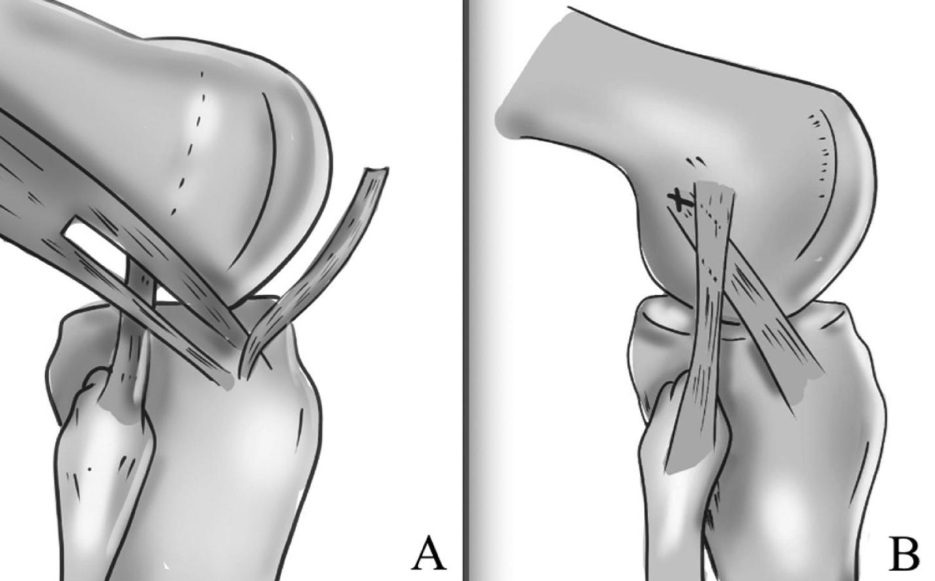
I perform the LET as an add-on to either ACL reconstruction or ACL repair. It is done through a surgical incision on the outer side of the knee — adding about 20 to 30 minutes to the procedure — and does not require a separate recovery. The LET uses a strip of tissue from the iliotibial band (the thick band of tissue that runs along the outside of the thigh) to create a new stabilizing structure on the outer side of the knee. The strip is left attached at its lower end near the tibia and passed underneath the lateral collateral ligament, then secured to the femur with a screw. This recreates the function of the injured anterolateral ligament and provides an additional check against the rotational forces that stress the ACL.
Not every ACL patient needs an LET. I consider adding it in specific situations where the risk of re-tear is elevated. The most common indications are young patients under 25 who plan to return to cutting and pivoting sports, patients with generalized joint hypermobility or laxity, and patients undergoing revision ACL surgery after a previous graft failure. A high-grade pivot shift on physical examination — which indicates significant rotational instability — is another strong indication. The landmark STABILITY study, the largest randomized trial on this topic, showed that adding LET to ACL reconstruction reduced graft rupture rates from 11 percent down to 4 percent at two years. A recent meta-analysis in the American Journal of Sports Medicine confirmed an approximately 65 percent reduction in re-tear risk when LET is added for high-risk patients.
An important point for patients: the LET changes your rehabilitation very little. In the first phase of rehab your therapist avoids resisted inward twisting of the shin to protect the LET. Otherwise you follow the same ACL reconstruction or BEAR recovery program whether or not the LET was performed. The additional procedure heals along with the ACL graft or repair, and the early restrictions, physical therapy progression, and return-to-sport criteria remain the same. The only thing that changes is the stability of your knee — and that is the whole point.
Recovery Timeline
Because the LET is performed at the same time as the ACL reconstruction or repair, the recovery timeline is determined by the ACL procedure itself — not the LET. If you are having an ACL reconstruction, your rehab follows our standard ACL reconstruction protocol. If you are having an ACL repair with the BEAR implant, you follow the BEAR protocol. Adding the LET does not add weeks to your recovery or change when you can start physical therapy, begin running, or return to sport.
For ACL reconstruction, the typical recovery involves physical therapy beginning within the first week, progressive strengthening over months three through six, a return-to-running program around four to five months, and return to full cutting and pivoting sports at nine months based on meeting strength and functional testing criteria. For ACL repair with the BEAR implant, the early phase involves a more structured brace and partial weight-bearing protocol, with return to sport typically at nine to twelve months. In both cases, the LET heals alongside the primary procedure. The only extra rule is no resisted inward twisting of the shin in the first phase of rehab.
Some patients may notice a bit more soreness on the outer side of the knee in the first few weeks after surgery compared to ACL surgery alone. This is from the additional incision and tissue work for the LET and resolves with standard rehab. Studies have shown no significant increase in stiffness, complications, or adverse events when LET is added to ACL surgery. The trade-off is overwhelmingly favorable: a brief additional procedure during surgery in exchange for a substantially lower risk of re-tearing your ACL when you return to sport.
The results speak for themselves. In the STABILITY trial, adding LET lowered graft rupture from 11 percent to 4 percent, about a two-thirds reduction, and functional outcomes — including range of motion, patient-reported scores, and return-to-sport rates — are equivalent to ACL reconstruction alone. For the right patient, LET is one of the most impactful things I can do to protect their knee and improve their chances of a successful, lasting return to athletics.
Surgery & Physical Therapy Resources
Discover detailed instructions and protocols to guide patients through Pre-Op, Post-Op and Physical Therapy from Dr. Merritt.
Related Articles
Read more from Dr. Merritt about adding LET to ACL reconstruction.
Common Lateral Extraarticular Tenodesis (ACL+) Questions
Injury Information
A: If you are having revision ACL surgery after a previous graft failure, adding LET is strongly considered. Revision cases have a higher risk of re-failure, and the additional rotational stability provided by LET helps protect the new graft. This is one of the primary indications for the procedure.
A: The concept is not new — lateral extra-articular procedures have been described since the 1970s. However, renewed interest in the anterolateral ligament and modern surgical techniques have brought the procedure back into the spotlight. The modified Lemaire technique that I use is supported by the largest randomized trial in this area (the STABILITY study) and recent international consensus statements recommending LET for high-risk ACL patients.
A: No. Your return-to-sport timeline is based on the ACL procedure, not the LET. For ACL reconstruction, return to cutting and pivoting sports is typically at nine months based on meeting strength and functional testing criteria. For ACL repair with the BEAR implant, return is typically nine to twelve months. The LET does not extend these timelines.
A: No. LET is specifically indicated for patients at elevated risk of re-tear. For a lower-demand patient or an older recreational athlete, ACL reconstruction alone provides excellent stability. The decision is individualized based on your age, activity goals, physical examination findings, and risk factors. We discuss this in detail before surgery.
A: I consider adding LET in patients at higher risk of ACL re-tear. The most common candidates are young athletes under 25 returning to cutting and pivoting sports, patients with generalized joint laxity or hypermobility, patients with a high-grade pivot shift on examination, and anyone undergoing revision ACL surgery after a previous graft failure. If you fall into one of these categories, we will discuss whether LET is right for you.
A: ACL+ (ACL Plus) is shorthand for ACL surgery plus the addition of a lateral extraarticular tenodesis. It reflects the idea that we are doing more than just the ACL — we are addressing the secondary rotational stabilizer on the outside of the knee as well. The goal is to give the knee the best possible stability before returning to high-demand activity.
A: The anterolateral ligament, or ALL, is a structure on the outer side of the knee that helps resist rotational forces. When you plant and twist, the ACL and ALL work together to stabilize the knee. In many ACL tears, the ALL is injured as well. If only the ACL is rebuilt and the ALL is not addressed, the knee can still have residual rotational instability — which increases the risk of re-tear when returning to pivoting sports.
Surgery Information
A: Yes, there will be an incision on the outer side of the knee, typically about three inches long. This is in addition to the incisions used for the arthroscopic ACL procedure and the graft harvest site. The scar is usually well-tolerated and fades over time.
A: The LET uses a strip of your own iliotibial band — the thick band of tissue that runs along the outside of the thigh from the hip to just below the knee. A portion of this tissue is harvested through an incision on the outer side of the knee, passed underneath the lateral collateral ligament, and secured to the femur. Using your own tissue means there is no need for a separate graft harvest or donor tissue.
A: This is a common concern, and the answer is reassuring. Studies, including the large STABILITY trial, have shown no significant increase in stiffness or loss of range of motion when LET is added. Some patients notice a bit more soreness on the outer side of the knee in the first few weeks, but this resolves with standard physical therapy. Long-term range of motion is equivalent to ACL surgery alone.
Post-Op Recovery
See what other patients say about their experience.
You deserve to move freely again. We will help you take that step.
Call to book an appointment
(425) 291-1496